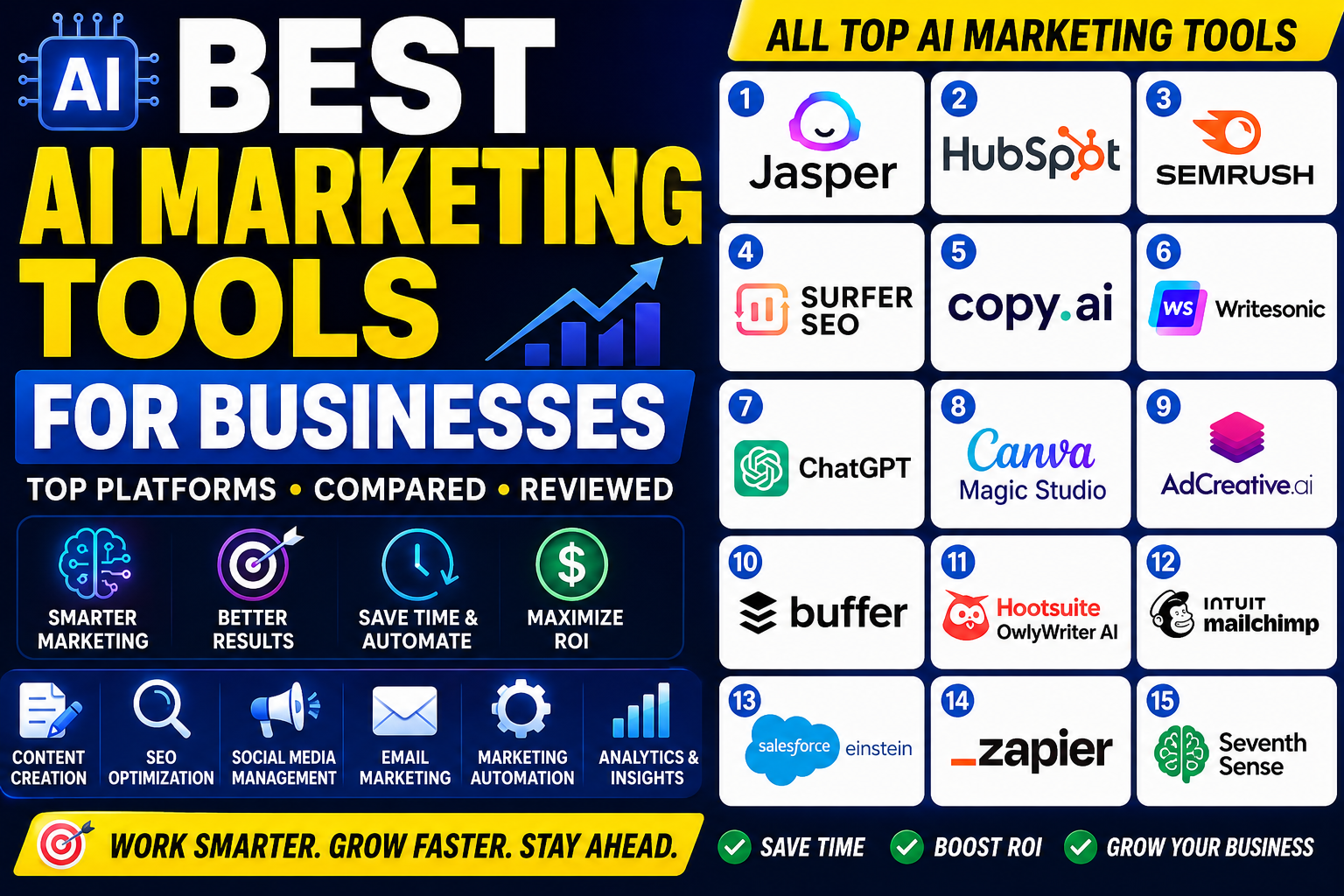
Artificial intelligence is no longer a futuristic concept reserved for large enterprises. Today, businesses of every size—from solo entrepreneurs and startups to global brands—are using AI to write content, create advertisements, automate emails, analyze customer behavior, and optimize marketing campaigns in ways that were unimaginable just a few years ago.
Imagine running a small online store with a team of just three people. Every week, you need to write blog posts, schedule social media content, design graphics, send email newsletters, and monitor website traffic. Completing all these tasks manually can quickly become overwhelming.
Now imagine having an AI assistant that drafts your blog posts in minutes, another that designs professional ad creatives, one that analyzes your SEO opportunities, and another that automates repetitive workflows while you focus on growing your business. That’s exactly why AI marketing tools have become essential in today’s competitive landscape.
However, not every AI marketing platform is worth your investment. Some excel at content creation, while others specialize in SEO, advertising, automation, or customer engagement. Choosing the wrong tool could mean spending hundreds of dollars every month without seeing meaningful results.
In this comprehensive guide, we’ll review the best AI marketing tools for businesses, compare their features, pricing, strengths, and weaknesses, and help you determine which solution best fits your marketing goals.
What Are AI Marketing Tools?
AI marketing tools are software applications that use artificial intelligence, machine learning, and data analysis to automate, improve, or simplify marketing activities.
Rather than replacing marketers, these tools enhance productivity by handling repetitive tasks, uncovering insights from data, and generating high-quality content at scale.
Businesses use AI marketing software to:
- Write blog articles
- Generate social media posts
- Create advertising campaigns
- Optimize SEO
- Design marketing graphics
- Personalize customer experiences
- Automate email marketing
- Analyze marketing performance
- Improve conversion rates
- Predict customer behavior
Instead of spending hours brainstorming ideas or manually analyzing reports, marketers can use AI to complete these tasks in minutes while maintaining consistency and quality.
How AI Is Transforming Digital Marketing
AI has fundamentally changed how businesses approach marketing.
A few years ago, creating a month’s worth of content might have taken an entire marketing team several weeks. Today, AI can generate first drafts, recommend keywords, analyze competitors, and even suggest the best publishing times.
For example:
A local real estate agency that once relied solely on Facebook ads began using AI-powered marketing tools to write property descriptions, automate email follow-ups, and generate ad creatives. Within a few months, the agency reduced its content production time significantly while increasing customer inquiries because its campaigns became more personalized and data-driven.
Stories like this are becoming increasingly common across industries.
Types of AI Marketing Tools
Not all AI marketing software serves the same purpose. Understanding the different categories will help you choose the right solution for your business.
AI Content Creation Tools
These platforms generate:
- Blog articles
- Product descriptions
- Website copy
- Marketing emails
- Landing pages
- Sales copy
Examples include Jasper AI, Copy.ai, and Writesonic.
AI SEO Tools
SEO-focused AI platforms help businesses:
- Discover keywords
- Optimize content
- Analyze competitors
- Build topical authority
- Improve search rankings
Popular options include Surfer SEO and Semrush.
AI Social Media Tools
These tools assist with:
- Caption writing
- Scheduling posts
- Repurposing content
- Performance analytics
- Audience engagement
Examples include Buffer AI and Hootsuite.
AI Email Marketing Tools
AI email platforms can:
- Personalize newsletters
- Predict customer engagement
- Optimize subject lines
- Automate follow-up campaigns
Mailchimp is a leading example.
AI Marketing Automation Platforms
Automation software connects different applications and reduces manual work.
Typical automations include:
- Lead nurturing
- CRM updates
- Customer onboarding
- Workflow automation
- Cross-platform integrations
Zapier AI is one of the most popular choices.
AI Advertising Tools
Advertising-focused AI platforms help marketers:
- Generate ad copy
- Create visual creatives
- Optimize campaigns
- Improve click-through rates
AdCreative.ai is one of the strongest options in this category.
Benefits of Using AI Marketing Tools
Businesses are adopting AI not because it’s trendy, but because it delivers measurable improvements in efficiency, creativity, and decision-making.
Here are some of the biggest advantages.
Save Time Through Automation
One of AI’s greatest strengths is handling repetitive tasks.
Instead of manually creating dozens of social media posts or writing multiple versions of an email campaign, AI can produce quality drafts within minutes.
This allows marketing teams to focus on strategy rather than repetitive production work.
Improve Marketing ROI
AI analyzes historical campaign data to identify what works and what doesn’t.
Businesses can allocate their budgets more effectively by focusing on campaigns that generate the highest returns.
Generate Better Content Faster
Writer’s block affects everyone.
AI tools provide ideas, outlines, headlines, and first drafts that marketers can refine instead of starting from a blank page.
This significantly accelerates content production without sacrificing quality when human editing is involved.
Make Better Decisions Using Data
Modern AI marketing software doesn’t just create content.
It analyzes:
- Customer behavior
- Conversion rates
- Traffic trends
- Campaign performance
- Audience preferences
These insights help businesses make smarter marketing decisions backed by data instead of guesswork.
Scale Marketing Operations
Growing businesses often struggle to keep up with increasing marketing demands.
AI makes it possible to publish more content, manage additional campaigns, and serve larger audiences without proportionally increasing team size.
How We Chose the Best AI Marketing Tools
There are hundreds of AI marketing platforms available today. To ensure our recommendations are practical and trustworthy, we evaluated each tool using consistent criteria.
Ease of Use
A powerful tool isn’t helpful if it’s difficult to learn.
We prioritized software with intuitive dashboards, clear documentation, and beginner-friendly interfaces.
AI Capabilities
We examined whether each platform offers meaningful AI functionality rather than simply adding AI as a marketing buzzword.
The best tools provide intelligent recommendations, automation, and high-quality outputs that genuinely improve productivity.
Integration Options
Marketing teams rarely use just one platform.
We favored tools that integrate seamlessly with popular services such as:
- Google Workspace
- Slack
- WordPress
- Shopify
- HubSpot
- Salesforce
- Zapier
Strong integrations reduce friction and help businesses build efficient workflows.
Pricing and Value
Expensive software isn’t always better.
We considered:
- Free plans
- Entry-level pricing
- Feature availability
- Scalability
- Overall value for money
This ensures our recommendations are suitable for businesses with different budgets.
Customer Support
Reliable support becomes especially important when businesses depend on software for daily operations.
We looked at:
- Documentation quality
- Live chat availability
- Email support
- Community resources
- Training materials
Quick Comparison of the Best AI Marketing Tools
| Tool | Best For | Starting Price | Free Plan | Overall Rating |
|---|---|---|---|---|
| Jasper AI | Content Marketing | Paid | No |  |
| HubSpot AI | CRM & Marketing Automation | Free plan available | Yes | |
| Semrush AI Toolkit | SEO & Competitive Research | Paid | Limited | |
| Surfer SEO | Content Optimization | Paid | No | ☆ |
| Copy.ai | Marketing Copy | Free plan available | Yes | ☆ |
| Writesonic | AI Writing | Free plan available | Yes | ☆ |
| ChatGPT | General AI Assistance | Free plan available | Yes | |
| Canva Magic Studio | AI Design | Free plan available | Yes | |
| AdCreative.ai | Paid Advertising | Trial | Limited | ☆ |
| Buffer AI | Social Media | Free plan available | Yes | ☆ |
1. Jasper AI
Overview
Jasper AI has established itself as one of the leading AI writing platforms for businesses that produce large volumes of marketing content. It’s designed for teams that need consistent, brand-aligned copy across blogs, emails, landing pages, and advertising campaigns.
Unlike basic AI chatbots, Jasper includes marketing-focused templates, brand voice controls, and collaborative features that make it especially useful for professional content teams.
Key Features
- AI blog writer
- Brand voice customization
- Marketing campaign creation
- Landing page generation
- Email copywriting
- Social media content
- SEO integrations
- Team collaboration
Pros
- Excellent content quality
- Easy-to-use interface
- Strong collaboration features
- Supports multiple content formats
- Ideal for marketing teams
Cons
- Higher pricing than some competitors
- Best results still require human editing
Pricing
Jasper offers several subscription plans for individuals and businesses, with pricing that scales based on features, usage, and team size.
Best For
Businesses that publish large amounts of marketing content and want consistent branding across multiple channels.
2. HubSpot AI
Overview
HubSpot has evolved beyond a CRM into a comprehensive AI-powered marketing platform. Its AI capabilities are integrated directly into its marketing, sales, customer service, and content management tools, making it a strong all-in-one solution.
Businesses that want to manage leads, automate email campaigns, create content, and analyze customer interactions from a single platform will appreciate HubSpot’s unified approach.
Key Features
- AI-powered email generation
- Smart CRM automation
- Lead scoring
- Marketing automation workflows
- AI content assistant
- Campaign analytics
- Customer segmentation
- Sales forecasting
Pros
- Comprehensive marketing ecosystem
- Excellent CRM integration
- Powerful automation features
- Scales well with business growth
- Generous free tools for small teams
Cons
- Premium features can become expensive as your business expands
- Some advanced capabilities have a learning curve
Pricing
HubSpot provides a robust free plan, while paid Marketing Hub tiers unlock more advanced automation, AI features, and reporting.
Best For
Small to medium-sized businesses and growing companies looking for an all-in-one platform that combines CRM, automation, and AI-powered marketing in a single ecosystem.
3. Semrush AI Toolkit
Overview
Semrush has long been recognized as one of the best SEO platforms, and its AI-powered features make keyword research, competitor analysis, content planning, and website optimization much easier. Instead of manually analyzing hundreds of keywords, marketers can use AI insights to identify opportunities that are more likely to drive traffic.
Key Features
- AI keyword research
- Content recommendations
- Competitor analysis
- Site audit
- Backlink analysis
- Position tracking
- AI writing assistance
Pros
- Excellent SEO database
- Accurate keyword metrics
- Comprehensive competitor analysis
- Powerful reporting tools
Cons
- Premium plans can be expensive
- Beginners may need time to learn the platform
Pricing
Offers multiple subscription plans with limited free access.
Best For
Businesses focused on SEO, content marketing, and organic traffic growth.
4. Surfer SEO
Overview
Surfer SEO helps marketers optimize content for search engines by analyzing top-ranking pages and recommending improvements. It removes much of the guesswork involved in SEO writing.
Key Features
- Content Editor
- NLP keyword suggestions
- SEO scoring
- SERP analysis
- Content audit
- AI content generation
Pros
- Easy-to-understand optimization score
- Excellent for blog writers
- Integrates with Google Docs and WordPress
Cons
- Limited features outside SEO
- Subscription required for advanced features
Best For
Bloggers, agencies, and businesses publishing SEO-focused content.
5. Copy.ai
Overview
Copy.ai is designed for marketers who need persuasive marketing copy quickly. It can generate product descriptions, emails, landing pages, advertisements, and social media captions in minutes.
Key Features
- AI copywriter
- Email generator
- Sales copy templates
- Blog outline generator
- Workflow automation
Pros
- Beginner-friendly
- Fast content generation
- Free plan available
Cons
- Long-form content often needs editing
- Less customizable than Jasper
Best For
Small businesses and startups needing quick marketing copy.
6. Writesonic
Overview
Writesonic combines AI writing with SEO features, making it an excellent option for businesses that regularly publish blog articles and website content.
Key Features
- Article writer
- Landing page generator
- AI chatbot
- SEO optimization
- Product descriptions
- Ad copy
Pros
- Produces quality first drafts
- Affordable pricing
- Good SEO capabilities
Cons
- Content still requires fact-checking
- Credit-based usage may limit heavy users
Best For
Content marketers and digital agencies.
7. ChatGPT
Overview
ChatGPT has become one of the most versatile AI assistants available. Businesses use it for brainstorming, customer support, content creation, coding, email writing, market research, and much more.
While it isn’t a dedicated marketing platform, its flexibility makes it one of the most valuable AI tools available.
Key Features
- Content generation
- Brainstorming
- Marketing strategy
- Coding assistance
- Customer support scripts
- Campaign planning
Pros
- Extremely versatile
- Easy to use
- Excellent conversational responses
- Free version available
Cons
- May produce outdated information if not using web-enabled features
- Requires good prompts for the best results
Best For
Businesses wanting an all-purpose AI assistant.
8. Canva Magic Studio
Overview
Visual content is essential in modern marketing, and Canva Magic Studio makes professional design accessible to everyone. Its AI tools can generate images, presentations, videos, social media graphics, and marketing materials with minimal effort.
Key Features
- AI image generation
- Magic Write
- Background remover
- Magic Resize
- AI presentations
- Video editing
Pros
- Beginner-friendly
- Huge template library
- Excellent collaboration features
Cons
- Some AI tools require a Pro subscription
- Limited advanced editing compared to professional design software
Best For
Businesses that create marketing graphics regularly.
9. AdCreative.ai
Overview
Creating high-performing advertisements often requires both creative expertise and extensive testing. AdCreative.ai simplifies this process by generating AI-powered ad creatives optimized for better engagement and conversions.
Key Features
- AI display ads
- Social media creatives
- Ad copy generation
- Performance predictions
- Brand customization
Pros
- Saves design time
- Excellent for paid advertising
- Optimized for conversions
Cons
- Primarily focused on advertising
- Premium pricing for larger teams
Best For
Businesses running Facebook, Instagram, Google, or LinkedIn advertising campaigns.
10. Buffer AI Assistant
Overview
Buffer has been a trusted social media management platform for years. Its AI Assistant now helps businesses generate engaging captions, repurpose content, and maintain a consistent posting schedule across multiple platforms.
Key Features
- Caption generator
- Post scheduling
- Content repurposing
- Social media analytics
- Team collaboration
Pros
- Easy to use
- Affordable
- Great scheduling features
Cons
- AI features are less advanced than specialized writing tools
- Limited analytics compared to enterprise solutions
Best For
Small businesses and social media managers.
Best AI Marketing Tools by Business Type
| Business Type | Recommended Tool | Why It Stands Out |
|---|---|---|
| Small Businesses | ChatGPT | Affordable, versatile, and easy to use |
| Startups | Copy.ai | Fast content creation with budget-friendly plans |
| Ecommerce Stores | HubSpot AI | CRM, automation, and customer insights |
| Agencies | Jasper AI | Brand voice, collaboration, and scalability |
| Enterprise Companies | HubSpot AI | Advanced automation and integrations |
| SEO Professionals | Semrush AI Toolkit | Industry-leading SEO insights |
| Content Creators | Writesonic | SEO-friendly long-form content |
| Social Media Managers | Buffer AI | Scheduling and AI-assisted captions |
| Designers | Canva Magic Studio | Professional graphics with AI features |
| Advertisers | AdCreative.ai | High-converting AI-generated ads |
Features to Look for in an AI Marketing Tool
Before investing in any AI marketing platform, consider these essential features:
- High-quality AI content generation
- Workflow automation
- CRM integration
- SEO optimization
- Analytics and reporting
- Collaboration tools
- Security and compliance
- Multi-language support
- Integration with existing software
- Flexible pricing that scales with your business
AI Marketing Tools vs Traditional Marketing Software
| AI Marketing Tools | Traditional Marketing Software |
|---|---|
| Automates repetitive tasks | Mostly manual workflows |
| Generates content | Requires manual writing |
| Predictive analytics | Basic reporting |
| Personalized customer experiences | Limited personalization |
| Faster campaign creation | Longer production time |
| Continuously learns from data | Static functionality |
For most modern businesses, AI doesn’t replace marketers—it enhances their productivity and allows teams to focus on strategy and creativity rather than repetitive tasks.
How to Choose the Right AI Marketing Tool
Choosing the right platform depends on your goals rather than simply selecting the most popular option.
Ask yourself:
- What marketing problem am I trying to solve?
- Do I need content creation, SEO, automation, or design?
- What’s my monthly budget?
- Will the software integrate with my existing tools?
- Can my team learn it quickly?
- Does it offer a free trial or free plan?
Testing two or three shortlisted tools before committing to a subscription is often the best approach.
Common Mistakes to Avoid
Many businesses fail to get the most from AI because they:
- Depend entirely on AI without human editing.
- Purchase multiple overlapping tools.
- Ignore integration capabilities.
- Overlook data privacy and security.
- Choose features they don’t actually need.
Remember, AI is most effective when paired with human creativity, critical thinking, and strategic oversight.
Frequently Asked Questions
What is the best AI marketing tool for small businesses?
ChatGPT, Copy.ai, and Canva Magic Studio are excellent choices for small businesses due to their affordability, ease of use, and wide range of capabilities.
Which AI marketing tool is best for SEO?
Semrush AI Toolkit and Surfer SEO are among the best options for keyword research, competitor analysis, content optimization, and improving search engine rankings.
Are AI marketing tools worth the investment?
Yes. Businesses that use AI effectively can save time, improve productivity, automate repetitive tasks, and make better marketing decisions based on data.
Can AI replace digital marketers?
No. AI is designed to assist marketers, not replace them. Human creativity, strategic thinking, and relationship building remain essential.
Are there free AI marketing tools?
Yes. ChatGPT, Canva, HubSpot, Copy.ai, Buffer, and Writesonic all offer free plans or free trials with useful features.
Which AI marketing tool is best for content creation?
Jasper AI is widely regarded as one of the best for professional marketing content, while Writesonic and Copy.ai are excellent alternatives for businesses with smaller budgets.
Final Verdict
Artificial intelligence has transformed the way businesses approach marketing, making it easier than ever to create content, automate workflows, optimize campaigns, and engage customers more effectively. The right AI marketing tool depends on your specific goals, budget, and team size.
If you’re looking for the best overall solution, Jasper AI stands out for its exceptional content creation capabilities and collaboration features. HubSpot AI is ideal for businesses that want an all-in-one marketing and CRM platform, while Semrush AI Toolkit remains the top choice for SEO professionals. For visually engaging campaigns, Canva Magic Studio simplifies design, and AdCreative.ai is a powerful option for businesses focused on paid advertising.
Ultimately, AI works best as a partner rather than a replacement for human expertise. By combining intelligent automation with thoughtful strategy and creativity, businesses can improve efficiency, deliver more personalized customer experiences, and achieve stronger marketing results in an increasingly competitive digital landscape.