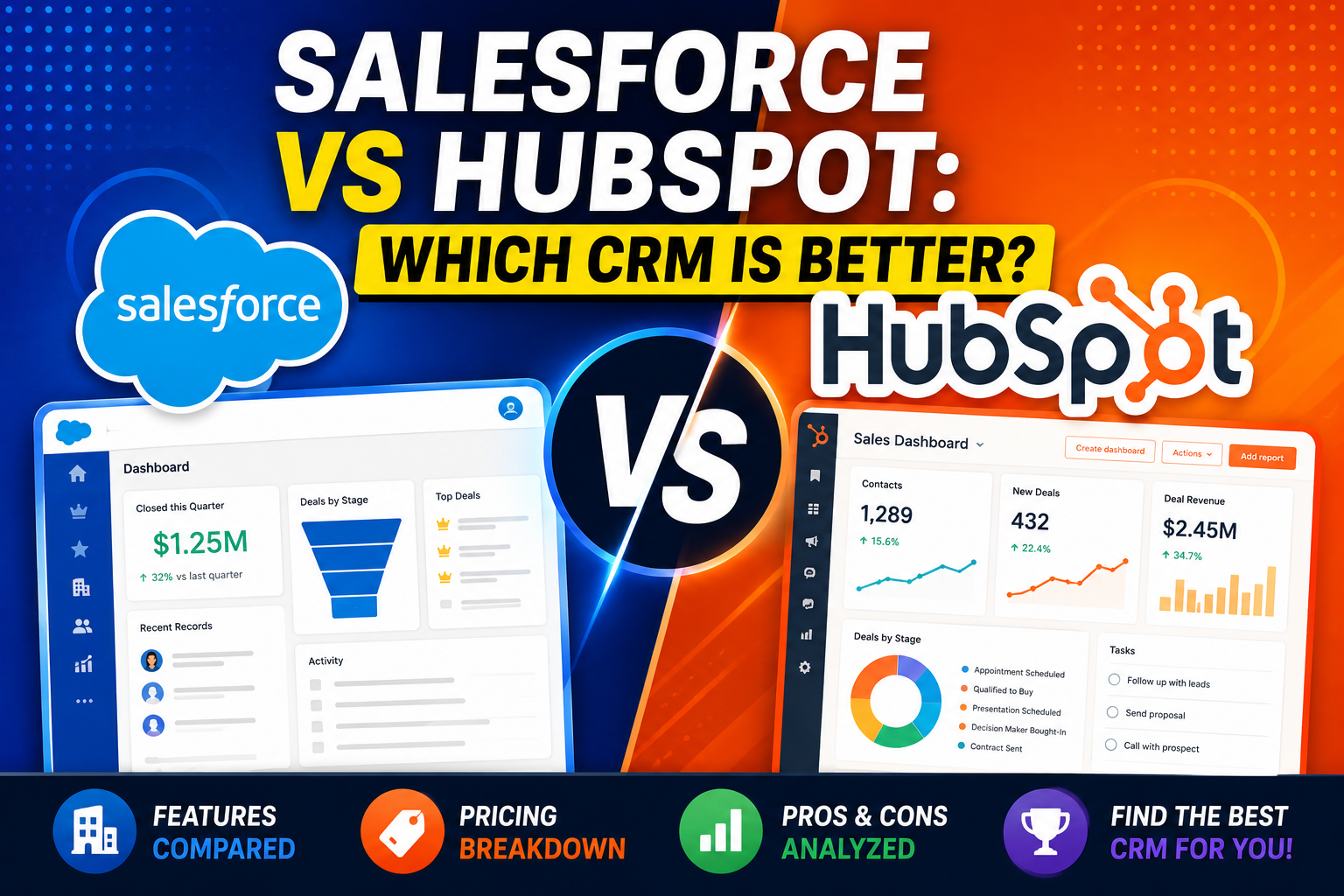
Choosing the right Customer Relationship Management (CRM) platform is one of the most important decisions a business can make. A CRM isn’t just a place to store contacts—it’s the backbone of your sales, marketing, and customer service operations.
Among today’s CRM giants, Salesforce and HubSpot consistently rank at the top. Both offer powerful tools for managing customer relationships, automating workflows, and driving business growth. Yet they take very different approaches.
Salesforce is known for its enterprise-grade customization and extensive ecosystem, while HubSpot has built a reputation for simplicity, inbound marketing, and an excellent free CRM.
I remember working with two companies around the same time that chose different paths. A fast-growing SaaS startup adopted HubSpot because the sales and marketing teams needed something intuitive that everyone could use immediately. Meanwhile, a larger consulting firm selected Salesforce because it required advanced reporting, custom workflows, and integrations with dozens of existing business systems. Both companies made the right choice—not because one CRM was objectively better, but because each matched their unique needs.
In this comparison, we’ll break down Salesforce and HubSpot side by side, comparing their features, pricing, automation, AI capabilities, integrations, customer support, and overall value to help you determine which CRM is the better fit for your business.
Salesforce vs HubSpot: Quick Verdict
| Category | Winner |
|---|---|
| Best Overall | 🏆 Salesforce |
| Best for Small Businesses | 🏆 HubSpot |
| Best Free CRM | 🏆 HubSpot |
| Best for Enterprise Businesses | 🏆 Salesforce |
| Best for Marketing Teams | 🏆 HubSpot |
| Best for Large Sales Teams | 🏆 Salesforce |
Our Recommendation
Choose Salesforce if you need a highly customizable CRM capable of supporting complex sales processes, enterprise reporting, and long-term scalability.
Choose HubSpot if you want an intuitive CRM with built-in marketing tools, faster implementation, and a generous free plan.
Salesforce vs HubSpot at a Glance
| Feature | Salesforce | HubSpot |
|---|---|---|
| Best For | Medium & Enterprise Businesses | Small & Growing Businesses |
| Free Plan | Limited Trial | ✅ Yes |
| Ease of Use | ⭐⭐⭐⭐☆ | ⭐⭐⭐⭐⭐ |
| Marketing Tools | ⭐⭐⭐⭐☆ | ⭐⭐⭐⭐⭐ |
| Automation | ⭐⭐⭐⭐⭐ | ⭐⭐⭐⭐☆ |
| AI Features | Einstein AI | Breeze AI |
| Integrations | 7,000+ | 1,700+ |
| Overall Rating | ⭐⭐⭐⭐⭐ | ⭐⭐⭐⭐☆ |
What is Salesforce?
Salesforce is one of the world’s leading CRM platforms, trusted by businesses of all sizes—from startups to Fortune 500 companies. Founded in 1999, it pioneered cloud-based CRM software and has since expanded into a comprehensive suite of products covering sales, marketing, service, commerce, analytics, and AI.
Key Strengths
- Advanced sales management
- Deep customization
- Powerful reporting
- Workflow automation
- Large app marketplace
- Enterprise-grade scalability
Salesforce is particularly well-suited for organizations with complex sales processes and dedicated CRM administrators.
What is HubSpot?
HubSpot started as an inbound marketing platform but has evolved into a complete CRM ecosystem. Its platform includes specialized hubs for Marketing, Sales, Service, Content, Commerce, and Operations, all built around a central CRM.
Why Businesses Choose HubSpot
- User-friendly interface
- Excellent free CRM
- Strong marketing automation
- Fast implementation
- Integrated tools
For startups and small businesses, HubSpot offers a straightforward way to manage customer relationships without a steep learning curve.
Feature Comparison
Contact Management
Both platforms excel at storing and organizing customer information.
Salesforce offers extensive customization, allowing businesses to create custom objects and fields tailored to their workflows.
HubSpot focuses on simplicity, providing clean contact records enriched with email history, website activity, and deal information.
Winner: Salesforce (for flexibility)
Lead & Pipeline Management
Sales teams need visibility into every stage of the sales funnel.
Salesforce allows highly customizable pipelines, forecasting, and opportunity management.
HubSpot makes it easy to create and manage pipelines using an intuitive drag-and-drop interface.
Winner: Salesforce
Marketing Automation
Marketing is where HubSpot truly shines.
It includes:
- Email campaigns
- Landing pages
- Forms
- Lead nurturing
- Social media scheduling
- Campaign analytics
Salesforce also offers powerful marketing capabilities through Marketing Cloud, but they often require additional products and configuration.
Winner: HubSpot
AI Capabilities
Artificial intelligence has become an essential feature in modern CRM software.
Salesforce Einstein AI
- Predictive lead scoring
- Opportunity insights
- Sales forecasting
- AI-generated emails
- Customer recommendations
HubSpot Breeze AI
- Content generation
- Email assistance
- Workflow suggestions
- Meeting summaries
- Customer insights
Winner: Salesforce
Reporting & Dashboards
Salesforce offers one of the most advanced reporting systems in the CRM industry.
Businesses can create highly customized dashboards, forecast revenue, and analyze sales performance across multiple teams.
HubSpot provides excellent reports but is generally simpler and easier to understand.
Winner: Salesforce
Mobile Experience
Both platforms provide polished mobile apps.
Users can:
- Manage contacts
- Track deals
- Schedule meetings
- Receive notifications
- Access dashboards
The mobile experience is smooth on both platforms.
Winner: Tie
Ease of Use
Ease of use is often the deciding factor for startups and smaller businesses.
HubSpot’s interface is modern, clean, and intuitive. Most users can begin managing contacts and deals within hours.
Salesforce, while extremely powerful, requires more setup and training to unlock its full potential.
| Category | Salesforce | HubSpot |
|---|---|---|
| Interface | ⭐⭐⭐⭐☆ | ⭐⭐⭐⭐⭐ |
| Navigation | ⭐⭐⭐⭐☆ | ⭐⭐⭐⭐⭐ |
| Learning Curve | Moderate | Easy |
| Setup Time | Longer | Shorter |
Winner: HubSpot
Pricing Comparison
Pricing structures vary significantly between the two platforms.
| Plan | Salesforce | HubSpot |
|---|---|---|
| Free CRM | Trial | ✅ Yes |
| Entry-Level | Available | Available |
| Professional | Yes | Yes |
| Enterprise | Yes | Yes |
Value for Money
HubSpot offers exceptional value for startups thanks to its generous free CRM and accessible pricing.
Salesforce becomes more cost-effective as businesses require advanced customization, automation, and scalability.
Integrations
Modern businesses rely on multiple software platforms, making integrations essential.
Both CRMs integrate with popular tools such as:
- Slack
- Gmail
- Outlook
- Microsoft Teams
- Shopify
- Zapier
- Zoom
- Stripe
- QuickBooks
Salesforce’s AppExchange provides one of the largest ecosystems of business applications available.
Winner: Salesforce
Security
Security is a priority for businesses handling sensitive customer data.
Both platforms provide:
- Two-factor authentication
- Data encryption
- User permissions
- GDPR compliance
- Single Sign-On
- Audit logs
Salesforce offers more advanced enterprise security controls, making it a preferred choice for highly regulated industries.
Customer Support
Salesforce
- Knowledge Base
- Community Forums
- Phone Support
- Premium Support Plans
HubSpot
- Help Center
- Academy
- Community
- Email Support
- Chat Support
HubSpot Academy deserves special recognition for its extensive educational resources, which help users get the most from the platform.
Pros & Cons
Salesforce
Pros
- Highly customizable
- Industry-leading automation
- Powerful reporting
- Massive integration ecosystem
- Enterprise scalability
Cons
- Higher learning curve
- Can become expensive
- Setup often requires specialists
HubSpot
Pros
- Easy to learn
- Excellent free CRM
- Outstanding marketing tools
- Fast implementation
- Clean user interface
Cons
- Advanced features require premium plans
- Less customizable than Salesforce
- Enterprise functionality is more limited
Salesforce vs HubSpot Scorecard
| Category | Salesforce | HubSpot |
|---|---|---|
| Ease of Use | ⭐⭐⭐⭐☆ | ⭐⭐⭐⭐⭐ |
| Features | ⭐⭐⭐⭐⭐ | ⭐⭐⭐⭐☆ |
| Marketing | ⭐⭐⭐⭐☆ | ⭐⭐⭐⭐⭐ |
| Automation | ⭐⭐⭐⭐⭐ | ⭐⭐⭐⭐☆ |
| Reporting | ⭐⭐⭐⭐⭐ | ⭐⭐⭐⭐☆ |
| Integrations | ⭐⭐⭐⭐⭐ | ⭐⭐⭐⭐☆ |
| Pricing | ⭐⭐⭐☆☆ | ⭐⭐⭐⭐☆ |
| Overall | ⭐⭐⭐⭐⭐ | ⭐⭐⭐⭐☆ |
Which CRM Should You Choose?
Choose Salesforce If:
- You’re a medium or large business.
- You need advanced reporting and forecasting.
- Your sales process is highly customized.
- You expect significant business growth.
- You have a dedicated CRM administrator or IT team.
Choose HubSpot If:
- You’re a startup or small business.
- You want to get up and running quickly.
- Marketing automation is a priority.
- You need a capable free CRM.
- Your team prefers a simple, intuitive interface.
Best Alternatives
While Salesforce and HubSpot are excellent options, they’re not the only CRM solutions worth considering.
| CRM | Best For |
|---|---|
| Zoho CRM | Budget-conscious businesses |
| Pipedrive | Sales-focused teams |
| Freshsales | Growing SMBs |
| Microsoft Dynamics 365 | Microsoft ecosystem users |
| Monday CRM | Workflow customization |
| Close CRM | Inside sales teams |
Frequently Asked Questions
Which is better, Salesforce or HubSpot?
It depends on your business. Salesforce is ideal for larger organizations needing advanced customization and scalability, while HubSpot is better suited for startups and small businesses looking for an intuitive, all-in-one CRM.
Is HubSpot cheaper than Salesforce?
Generally, yes. HubSpot’s free CRM and entry-level plans make it more accessible for smaller businesses, while Salesforce’s costs can increase as you add users and advanced features.
Can HubSpot replace Salesforce?
For many startups and small businesses, yes. However, enterprises with highly customized workflows or complex reporting requirements may find Salesforce a better long-term fit.
Which CRM is easier to use?
HubSpot is widely regarded as easier to learn and navigate, making it an excellent choice for teams without dedicated CRM administrators.
Which CRM is better for marketing?
HubSpot. Its integrated Marketing Hub, email automation, landing pages, and content management tools make it particularly strong for inbound marketing.
Does Salesforce integrate with HubSpot?
Yes. Businesses can integrate Salesforce with HubSpot to synchronize contacts, leads, deals, and marketing data between the two platforms.
Final Verdict
Both Salesforce and HubSpot are exceptional CRM platforms, but they cater to different types of businesses.
Salesforce stands out for its unmatched customization, enterprise-grade reporting, and scalability. It’s the CRM of choice for organizations with complex sales operations, multiple departments, and ambitious growth plans.
HubSpot, on the other hand, delivers an outstanding experience for startups and growing businesses. Its intuitive interface, powerful marketing tools, and generous free CRM make it easy to adopt and quick to deliver value.
Our Recommendations
| If You Need… | Choose… |
|---|---|
| Best Overall CRM | 🏆 Salesforce |
| Best for Startups | 🏆 HubSpot |
| Best Free CRM | 🏆 HubSpot |
| Best Marketing Platform | 🏆 HubSpot |
| Best for Enterprise | 🏆 Salesforce |
| Best Customization | 🏆 Salesforce |